
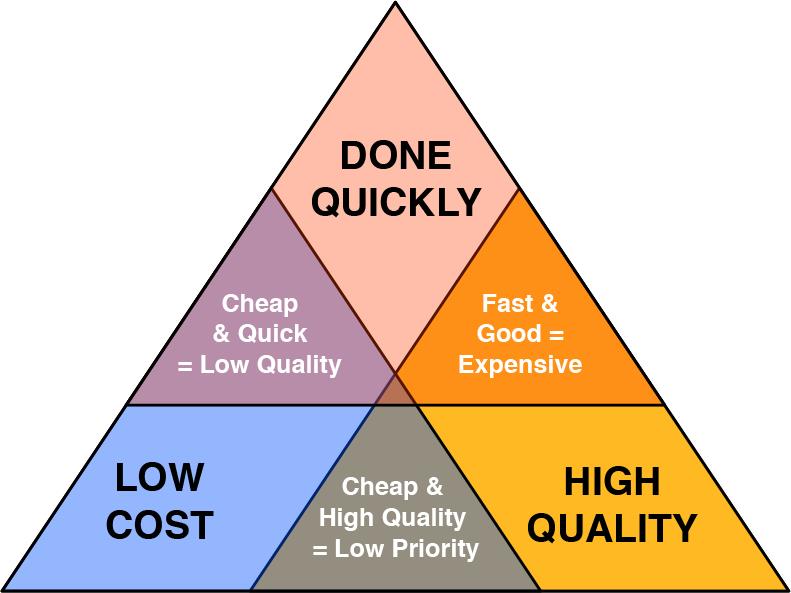
It’s a well known fact that in a capitalist society you have to focus on certain aspects of production while sacrificing others. In its basic form this is shown as a triangle, with Time, Quality and Cost at each point. You can have something made fast and cheap, but the quality usually suffers. You can take your time and make something of higher quality, but that equates to a higher cost. Finally, you can ask for something cheaper but better quality, but don’t expect it to be a priority. Time is money after all.
When I create items – be it something printed or carved from wood – I try to make quality the priority. Sure, sometimes I rush parts of a project, but I’m usually not happy about it and feel a sense of guilt knowing I could’ve done better given the time. The majority of projects I start have a lot of background tasks too – overheads that aren’t usually added to the cost of a project directly. This means tools, materials, maintenance costs and time, but it also covers developed skills and knowledge. After all, without the knowledge of maintaining the printers and the skill used to upgrade them – usually with a view to increase quality – I would be like all the others that have plug-and-play attitude, one that comes to a standstill at the sign of a fault or breakage. Similarly, the time to properly set up and care for one’s tools takes a certain amount of knowledge and trial and error. The edge of a chisel can’t just be sharpened with a file at any random angle, but a whetstone and oil take some small amount of skill to use effectively.
It’s for these reasons that my filament-using printers are dialed in to use 0.2mm nozzles (the smallest one can feasibly purchase and use with minimal issue) and print at a fairly small 0.08mm layer height. Could I aim smaller? Absolutely, though printing at 0.04mm – the minimum height for most printers at that nozzle size – has almost no benefit when looking at the time/quality relationship. Because of the limiting factors of nozzle size, layer height and printer speed – which I tent to keep around 60mm/s – a print that might take another person mere hours can take a day or two for me.
Value for Money
This is part of why you may find similar or equivalent items elsewhere on the internet for a lower cost. Whether they sacrificed quality in order to speed up their process or are simply undercutting others to gain orders, the end result will be two similar items that vary in quality but appear the same to a buyer. I believe the phrase ‘buy cheap, buy twice’ is quite accurate in this sense, as I know from experience buying cheaper sharp-edged dice from a mass-produced set rather than purchasing from an independent business.
The Masses
This leads me to the second part of capitalism in this instance: mass production. There are many companies out there who pride themselves in churning out product after product in as quick a time as possible, flooding the market with cheaper variations and offering sales or free shipping, knowing that they’ll somehow recoup the cost by sheer amount moved. This is inherently bad for smaller or starter businesses trying to compete, as the time and effort put into things like hand-made custom dice can’t compete with sets upon sets of vat-cast polyhedral sets offered in most game stores, for example. There are exceptions to this rule; many who create bespoke products like myself have an element of uniqueness that some buyers are willing to pay for, though the cost can be high given the attention to detail or quality in most cases.
Confidence is Key
Thirdly, and possibly finally, there’s a lot to say about having confidence as a seller, especially as a small independent business. If, like me, you undervalue your work continuously, you attach prices that undercut the market. This leads to those who may not understand the process or the work that goes in to creating those products assuming that every version of that product should then be that price or near enough, leading to the question ‘why is their product this price and yours is more expensive?’ Trying to then explain the extra care and attention attached to your particular product often falls on deaf ears.
As a second to this point, occasionally sellers won’t even know the value of what they’re selling. This is often seen on personal marketplace posts – think Facebook Marketplace, Gumtree or Craigslist. This leads to the same assumption as above: why did they sell this particular furniture for so cheap while this one is so expensive? The obvious assumption is that the more expensive one is trying to rip you off for obscene profit, while in reality the cheaper seller may just assume it’s ‘just a table’ without really knowing or caring what they have. I’ve personally found some great items by accident with this exact misunderstanding.
The Point
So why am I writing this post with an emphasis on quality over time? As one of the more popular products I’ve sold, I approached lithophanes with a mindset that emphasised creating a clear, high quality result. After all, most – if not all – of the orders were of loved ones or memories, which I felt deserved an attitude aligning with ‘do it right first time.’ The downside to this was that many of them took more than a day to print, but I felt it was a necessary step to ensure happy customers. As a result I charge a slightly higher rate than those on Ebay or Etsy on occasion, preferring to avoid handing out products that forego the sharpest image in favour of a speedy result. This has continued into all other prints, extending even to resin prints which are inherently much more detailed regardless, and is something I will continue to uphold in my personal goal to create products of quality.
Let’s call it a core value of KoZy Crafting.
 KoZy Crafting
Leave a comment